

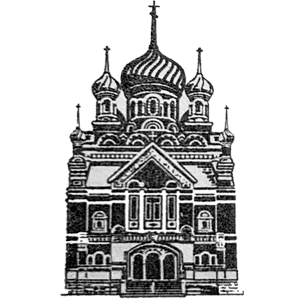
SAINT NICHOLAS PATRIARCHAL CATHEDRAL IN NEW YORK CITY
HISTORY OF CONSTRUCTION“Amid the massive yet ungainly heterodox churches and the towering buildings of New York that impress by sheer height alone, the majestic Orthodox cathedral stands out sharply with its wondrous architecture…
…Majestic is the Orthodox Russian church in New York! — so will say anyone who looks at it for the first time — and it speaks much to the Russian Orthodox heart! “
— Russian Orthodox American Messenger, 1902
HISTORY OF SAINT NICHOLAS CATHEDRAL
St. Nicholas Cathedral was built more than a hundred years ago. At the origins of its history stood great saints of the Russian land — St. Tikhon, Patriarch of Moscow and All Rus’, and the New Martyr Protopresbyter Alexander Hotovitzky.
At the end of the 19th century, a large colony of immigrants of Orthodox origin formed in New York, mainly from the western regions of Ukraine and Belarus. For a long time their poor financial situation did not allow the immigrants to have a church of their own.
In 1870, by commission of the Holy Synod, the first Greek-Russian church in the city was established in a private house on Second Avenue. It was attended by Greeks, Serbs and Syrians, but mainly by diplomats and staff of the consulate of the Russian Empire, which is why it became known as the “consular” church. Its rector was Fr. Nicholas Bjerring, a Dane by birth who had converted from Catholicism to Orthodoxy. Before embracing Orthodoxy, Fr. Nicholas had been a professor of philosophy and history at the Catholic seminary in Baltimore.
Nicholas Bjerring was a personal friend of U.S. President Ulysses S. Grant and, having extensive connections in society, zealously preached Orthodoxy on the American continent; in particular, he published “The Oriental Church Magazine,” which was widely circulated in the United States.
In 1894 Bishop Nicholas of the Aleutians and Alaska founded a new house church in New York dedicated to St. Nicholas the Wonderworker of Myra. He appointed Archpriest E. Balanovich its rector, and in October 1895 Alexander Alexandrovich Hotovitzky, a native of Kremenets in Volhynia Province and a graduate of the Volhynia Theological Seminary and the St. Petersburg Theological Academy, was appointed psalm-reader of the church. On February 25, 1896, Bishop Nicholas ordained him a priest and appointed him rector in place of Priest E. Balanovich. Although services continued to be held in the house church, the church authorities continued to study the question of building a separate church in New York.
In 1899 a committee was formed to look for ways to acquire land and build a church in the city. In September of that year a lot was purchased for a total of $36,000 (72,000 rubles), toward which the Holy Synod immediately contributed 44,000 rubles. The plan was to build on this lot a church for 900 people, together with rooms for a Sunday school, an assembly hall and apartments for the clergy. The estimated cost of construction was 114,000 rubles, or $57,000, and in February 1900, with the blessing of the Holy Synod, which had received the Highest permission of Emperor Nicholas Alexandrovich to raise the necessary funds, Fr. Alexander Hotovitzky, as chairman of the building committee, traveled to Russia for this purpose.

Patriarch Tikhon (Belavin)

Hieromartyr Alexander Hotovitzky

St. John of Kronstadt

Emperor Nicholas II
The first contribution, 5,000 gold rubles, came from the family of Emperor Nicholas II. On the letter about building a church in America, the Emperor wrote the following resolution: “This matter is of great state importance.” Invaluable prayerful and moral support for the construction was given by Fr. John of Kronstadt, who contributed 200 rubles of his own money and wrote on the first page of the book specially kept for recording donations: “May the Lord bless this book and the work for which these donations are requested…”
Many Orthodox people in Russia followed the example of the Royal Family and the pastor of Kronstadt. Often, after Fr. Alexander Hotovitzky’s appeals from the ambo, parishioners donated their own earrings, rings, necklaces and bracelets. In a short time 80,000 rubles were collected. Nevertheless, the funds raised were insufficient, and the Holy Synod declared January 6 (19), 1901 — the feast of Theophany — a day of collection for the construction of an Orthodox church in New York. On this great feast, all of Russia gathered donations to help their brothers and sisters in distant America.


The contract for the construction of the cathedral. Report with the resolution of St. Tikhon
On May 9 (22), 1901, the feast of the Translation of the Relics of St. Nicholas the Wonderworker of Myra, the cornerstone of the new church was laid. The stone was blessed by Bishop Tikhon of the Aleutians and North America, the future Patriarch of All Russia and Confessor of the Church of Christ. That day a procession took place in New York with thousands of the faithful, including members of the crew of the legendary battleship Retvizan, then under construction in Philadelphia, which later became famous in the Russo-Japanese War. The sailors donated to the future church an altar cross, which is kept in St. Nicholas Cathedral to this day. All along the route of the procession from the church on Second Avenue to 97th Street in Manhattan, the houses were decorated with Russian and American flags.
A year and a half later, the leading American construction firm of the time, John Downey & Son, built St. Nicholas Cathedral to the design and under the supervision of the Russian architect I.V. Bergesen, in a style unique for New York.
On November 10 (23), 1902, Bishop Tikhon performed the Great Consecration of the church and celebrated the first Divine Liturgy. About three thousand people attended the consecration, among them the Russian Ambassador Extraordinary Count A.P. Cassini, representatives of the Russian Embassy, New York Mayor S. Low, Consul General N.N. Lodyzhensky, the Russian Minister to Korea A.P. Pavlov, the Russian Consul in Canada N.B. Struve, and representatives of various confessions.
In his address of welcome, Bishop Tikhon said: “…we have often lamented that our church was poor, cramped and inconvenient. Now an end has been put to such lamentations, and the Lord has heard our heartfelt sighs that in this great city a church be erected worthy of the Russian people and befitting the majesty of the Orthodox faith! True, in its riches our new church yields to many churches of the great Russian land, but, like Solomon’s temple, it has a missionary significance: we trust that people of other confessions will hear of it, and will come into it, and will pray here, and will lift up their hands to our God.”
In 1905 St. Tikhon, elevated to the rank of archbishop, moved the diocesan center from San Francisco to New York, and St. Nicholas Church became a cathedral, taking on the mission of the spiritual center of Russian Orthodoxy in North America, where all the subsequent bishops of our Church carried out their ministry.

Assumption Church at the Russian Emigration House ~ 1890

St. Nicholas Church on 2nd ave ~ 1895

Vladyka Tikhon and A. Toth after a service at the church on 2nd Avenue
The revolution of 1917 in the distant homeland affected the cathedral in New York as well. In the post-revolutionary period, especially in the 1920s, normal spiritual life at St. Nicholas Cathedral was disrupted. Cathedral property began to be sold to pay off loans. Nor did the cathedral escape seizure by the Renovationists, so common in those years. In 1924 the Renovationist “archbishop” I. Kedrovsky arrived in New York, calling himself the official representative of the Russian Church sent from Moscow; through the civil courts he took possession of the cathedral and held it until his death in 1934. After Kedrovsky’s death his sons Nicholas and John continued to serve in the cathedral, one in “episcopal” and the other in “priestly” rank. Both were likewise connected with the “Living Church.” In 1944 Nicholas Kedrovsky died. His brother John Kedrovsky, having lost legal support and the hierarchical leadership of his group, joined Metropolitan Benjamin (Fedchenkov), then in the USA as the representative of the Moscow Patriarchate.
In 1933 Archbishop Benjamin, with the blessing of Metropolitan Sergius, went to the USA to give a series of lectures. During his stay, by decree of November 29 of the same year, he was appointed Temporary Exarch of America, Archbishop of the Aleutians and North America. Over 14 years of ministry in the USA, toward the end of which he was raised to the rank of metropolitan, Vladyka Benjamin was able to revive the life of the Patriarchal Church, in particular founding about 50 new parishes.
On July 2, 1941, a few days after Germany’s treacherous attack on the Soviet Union, he gave a speech at a huge rally at New York’s Madison Square Garden that made an enormous impression on those gathered: “Everyone knows that the most terrible and decisive moment has come for the whole world. It can and must be said that the fate of the world depends on the outcome of events in Russia… And therefore the intention of the President and other statesmen to cooperate with Russia must be welcomed… All Rus’ has risen! We will not sell our conscience and our Homeland!” According to the newspapers, these words literally electrified the audience of many thousands.


Laying of the cathedral cornerstone, 1901
In 1945 the return of the cathedral to the Moscow Patriarchate was recognized as lawful, but this recognition was not yet final. The lawsuit begun by Metropolitan Platon (Rozhdestvensky), who had not accepted the directives of His Holiness Patriarch Tikhon, continued, although the Metropolitan himself was no longer alive. The case over the ownership of the cathedral passed from one court to another and ultimately dragged on for 36 years. In 1947 a New York State court ruled that the representatives of the Moscow Patriarchate and the congregation must leave St. Nicholas Cathedral.
In this difficult time a Presbyterian church provided the community with its church on 96th Street for services, and only by the decision of the U.S. Supreme Court of November 23, 1952, was the cathedral returned to the Moscow Patriarchate. Attorney F. Adler brilliantly won the case, as Metropolitan Makary (Ilyinsky) reported in a telegram to Patriarch Alexy I of Moscow dated November 24, 1952: “We have won the court case over the cathedral… I ask that the rector of the cathedral, Archpriest Dzvonchik, be awarded the miter for his labors in the struggle for the cathedral. Glory to God for all things. We ask the prayers and blessing of Your Holiness for the labors ahead.” From that time the cathedral again became the seat in the USA of the Exarchs of the Moscow Patriarchate in North America and the center of the Russian Church in the USA.
Meanwhile, the New York State Court of Appeals disregarded the Supreme Court’s decision and handed the cathedral to the Russian Metropolia, which did not recognize the Patriarch of Moscow and was then headed by Metropolitan Leonty (Turkevich), so the litigation continued until 1960. By decision No. 824 of the U.S. Supreme Court of June 6, 1960, this judgment was reversed. Such a procedure is very rare and occurs only in exceptional cases. The New York Times of June 6, 1960, noted: “The Russian Orthodox Church today won a complete victory in a 15-year struggle with an American branch of the Church for possession of St. Nicholas Cathedral in New York.”
Since 1970, after autocephaly was granted to the Orthodox Church in America, St. Nicholas Cathedral has been designated the church of the Representation of the Moscow Patriarchate in the USA. At the same time it is the center of the Patriarchal Parishes, which, in accordance with the Tomos of autocephaly, remained under the canonical jurisdiction of the Russian Orthodox Church and did not wish to join the Orthodox Church in America. St. Nicholas Cathedral remains the church of His Holiness the Patriarch of Moscow and All Rus’, who governs the parishes through his vicar bishops. The vicars also head the Representation in the USA.

The life of the cathedral in the second half of the 20th century is connected with the work of such outstanding hierarchs of the Russian Church as Metropolitan Boris (Vik), Metropolitan John (Wendland) and Metropolitan Nikodim (Rotov), who either carried out their archpastoral ministry here or did much to strengthen the position of the Moscow Patriarchate in the USA. Years of trials, litigation and financial difficulties could not but affect the condition of the cathedral, which had not been altered since 1902 and had become dilapidated.
In 1954, under Metropolitan Germogen (Kozhin), repair work began to restore the roof, domes and cross, and continued under a number of subsequent bishops. An event reflecting the cathedral’s cultural significance dates to 1973: it became a New York City architectural landmark, and a bronze plaque describing the uniqueness of the building was placed on its wall.
By 2000 the condition of the church had become almost hazardous, and a decision was made to carry out major repairs and restoration work.
The work to recreate the cathedral’s artistic decoration coincided with the completion of the murals of the Cathedral of Christ the Savior in Moscow, which at the end of the 19th century was the model for many Russian churches. After its reconstruction in 2000, the Cathedral of Christ the Savior, as in the 19th century, became the model without which it would have been impossible to undertake the most complex restoration work in many churches of the Russian Orthodox Church — both in Russia and abroad.
Preparatory work and the gathering of material on the lost interior and murals began at the end of the 1990s. Because the reconstruction of the Cathedral of Christ the Savior required material held in the U.S. Library of Congress, Priest Leonid Kalinin, head of the Coordinating Group of Specialists for the Reconstruction of the Cathedral of Christ the Savior, was sent to America several times. While working with the materials in the Library of Congress, and with the personal assistance of the Librarian of Congress, Dr. J. Billington, part of the materials on the history of the construction of St. Nicholas Cathedral in 1900–1902 was found. The most significant results came from collecting documentary information about the cathedral from the archives of the Orthodox Church in America in Syosset, headed by A.P. Liberovsky.
The composition of the church’s murals is based on the traditional arrangement of subjects: from Christ the Pantocrator in the dome, downward through the Heavenly Powers, to the great events of the Gospel — the Transfiguration, the Crucifixion, the Ascension and the Descent of the Holy Spirit upon the Apostles — in the upper part of the church, on the concave surfaces of the “Heaven.”
Slightly lower, encircling the church, is a cycle of images revealing the Gospel story from the Nativity of Christ to the Dormition of the Mother of God.
Lower still is a cycle of four images from the life of St. Nicholas: “Deliverance from Execution,” “Rescue at Sea,” “Secret Almsgiving” and “Rebuking Arius at the First Ecumenical Council.”


The Representation of the Moscow Patriarchate in the USA is housed in the reconstructed building of St. Nicholas Cathedral; its tasks expanded considerably after the restoration was completed. The main mission of the Representation is to bear witness to the position of the Russian Orthodox Church in its contacts with those building Orthodox unity on American soil, with the non-Orthodox churches of the host country, religious leaders of other traditions, U.S. government institutions, and representatives of international organizations and the press. The Representation is staffed by clergy appointed to St. Nicholas Cathedral by decision of His Holiness the Patriarch and the Holy Synod.
This work was undertaken not for human glory but for the glory of God. For “Not unto us, O Lord, not unto us, but unto Thy name give glory.”
The New York Patriarchal Cathedral has been, and remains to this day, the principal church and meeting place for the spiritual unity of our compatriots. May the sacrificial participation of our compatriots in Russia and the United States of America in this holy work be a good and edifying example for many of our contemporaries and descendants.
May Thy Name, O Lord, be hallowed forever on this island of Russian Orthodoxy on the American continent, and may many begin and complete here their path to Thy Kingdom.
Remember, O Lord, all who labored diligently in this obedience, and “pour out upon them Thy rich mercies” both in this temporal life and in life eternal. Amen.


