

PATRIARCH OF THE RUSSIAN ORTHODOX CHURCH
Biography. Sermons. Ministry. Official Documents"The most important part of the mission of the Church has remained unchanged since the time of the apostles - to bear witness to our resurrected Lord and Savior Jesus Christ, to the eternal and unchanging moral law that God has placed in the hearts of mankind."
— His Holiness Patriarch Kirill
BIOGRAPHY
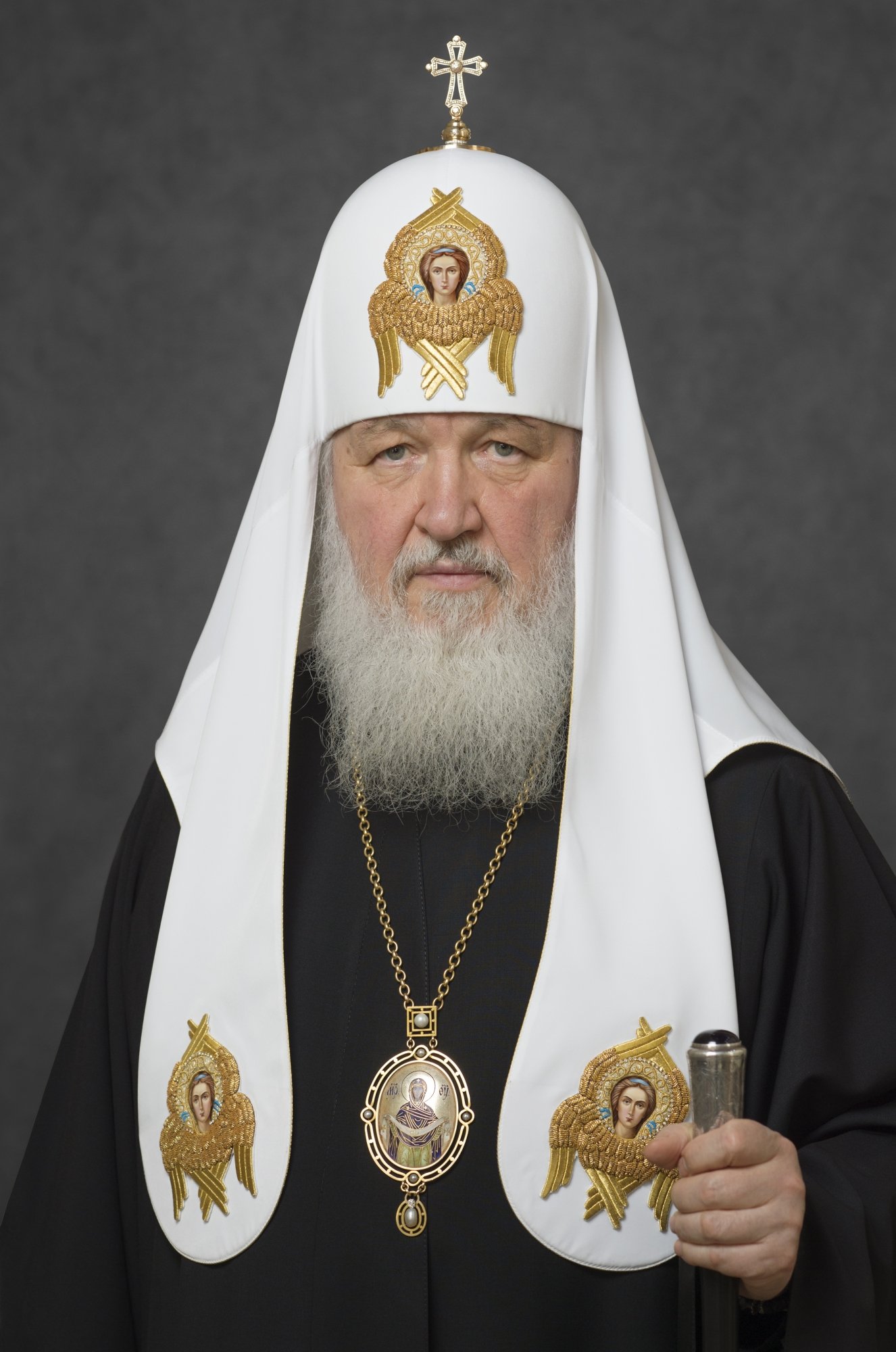
His Holiness Patriarch Kirill of Moscow and All Rus’
His Holiness Patriarch Kirill of Moscow and All Rus’ (secular name Vladimir Mikhailovich Gundyaev) was born on November 20, 1946, in Leningrad (St. Petersburg). His father, Mikhail Vasilyevich, was a priest; his mother, Raisa Vladimirovna, taught German at a school. His grandfather, Priest Vasily Stepanovich Gundyaev, was repeatedly imprisoned and exiled in the 1920s–1940s for his church activities and his struggle against Renovationism, and was a prisoner of the Solovki camp.
After graduating from secondary school in 1965, Vladimir Gundyaev entered the Leningrad Theological Seminary and then the Leningrad Theological Academy, from which he graduated with honors in 1970. On April 3, 1969, the future Patriarch was tonsured a monk with the name Kirill by Metropolitan Nikodim (Rotov) of Leningrad and Novgorod. On April 7 of the same year he was ordained a hierodeacon, and on June 1 a hieromonk.
From 1970 to 1971, Hieromonk Kirill taught dogmatic theology at the Leningrad Theological Academy, served as assistant to the inspector of the Leningrad theological schools and, at the same time, as personal secretary to Metropolitan Nikodim.
In September 1971, Hieromonk Kirill was elevated to the rank of archimandrite, and for the next four years was the representative of the Moscow Patriarchate at the World Council of Churches in Geneva. At the age of 29, on March 14, 1976, Archimandrite Kirill was consecrated bishop of Vyborg, and on September 2, 1977 he was elevated to the rank of archbishop.
For ten years Vladyka Kirill was rector of the Leningrad Theological Academy and Seminary, and in December 1984 he was appointed Archbishop of Smolensk and Vyazma.
From 1986 Archbishop Kirill also administered the parishes in the Kaliningrad Region, and in 1988 he became Archbishop of Smolensk and Kaliningrad. The future Patriarch headed the Smolensk diocese for 25 years. Under him the Kaliningrad Region was included in the diocese, where the preaching of Orthodoxy began practically from scratch and the first Orthodox churches appeared. A seminary was opened in Smolensk, Orthodox gymnasiums appeared in the diocese, and 165 new parishes were opened.
On February 25, 1991, Archbishop Kirill was elevated to the rank of metropolitan. Along with governing the Smolensk diocese, Metropolitan Kirill labored as a church diplomat and scholar.
He regularly delivered lectures, including in Western universities, participated in inter-Christian dialogue, and repeatedly met with leaders of other Christian confessions and with leaders of foreign states.
From November 1989 to 2009, he was Chairman of the Department for External Church Relations and a permanent member of the Holy Synod.
As the head of the Department for External Church Relations, Metropolitan Kirill took an active part in the reunification of the two branches of the Russian Church. He also led the preparation of two important documents that determined the position of the Church regarding the most important social and political challenges of the 21st century - "Fundamentals of the Social Concept of the Russian Orthodox Church" and "Fundamentals of the Teaching of the Russian Orthodox Church on Human Dignity, Freedom and Rights."
In the course of his ministry Metropolitan Kirill took an active part in peacemaking efforts in the former Yugoslavia. During the war he repeatedly visited Belgrade, held talks with the Serbian leadership, and in May 1999 initiated the creation of an informal international Christian peacemaking group for Yugoslavia.
From 1994 Metropolitan Kirill was the author and host of the weekly television program “The Pastor’s Word” on Russia’s Channel One.
As chairman of the Commission of the Holy Synod for the revival of religious and moral education and charity, he initiated the creation of Synodal departments for religious education, social service and charity, and for cooperation with the armed forces and law enforcement agencies. He was the author of the Concept for the revival of charity and religious education, adopted by the Holy Synod on January 30, 1991. In 1994 he developed and submitted the Concept of Interaction between the Russian Orthodox Church and the Armed Forces for approval to the Holy Synod.
After the repose of His Holiness Patriarch Alexy II, on December 6, 2008, Metropolitan Kirill of Smolensk and Kaliningrad was elected from among the seven permanent members of the Holy Synod as Locum Tenens of the Patriarchal Throne.
On January 27, 2009, the Local Council of the Russian Orthodox Church elected Metropolitan Kirill Patriarch of Moscow and All Rus’ by secret ballot.
His Holiness Patriarch Kirill holds the degree of Candidate of Theology, is an honorary professor of a number of theological and secular universities in Russia and the West, and is the author of several books and more than 700 publications on various aspects of church life. He has received high state awards, as well as awards of the Russian Orthodox Church and of many Local Orthodox Churches.


LATEST NEWS FROM THE OFFICIAL WEBSITE OF THE MOSCOW PATRIARCHATE
Patriarchal Ministry:
- His Holiness Patriarch Kirill Offers a Prayer for the Repose of the Newly Reposed Schema-Metropolitan Platon (Udovenko)
- His Holiness Patriarch Kirill Meets with the Primate of the Church of Jerusalem
- Russian President V.V. Putin and His Holiness Patriarch Kirill Visit the Exhibition “The Christian Tradition: Our Days”
- The President of Russia and the Primate of the Russian Church Lay Flowers at the Monument to Kuzma Minin and Dmitry Pozharsky on Red Square
- On the Feast of the Kazan Icon of the Mother of God, His Holiness Patriarch Kirill Celebrates the Liturgy at the Dormition Cathedral of the Moscow Kremlin
- His Holiness Patriarch Kirill Celebrates the Liturgy at the St. Alexis Stauropegial Convent
- Address of His Holiness Patriarch Kirill on the Launch of the Humanitarian Operation in Aleshki, Kherson Region
- His Holiness Patriarch Kirill Celebrates the Liturgy at the Church of the Archangel Michael in the Village of Akulinino, Moscow Region
- The 4th International Congress of Choir Directors and Singers of the Russian Orthodox Church Concludes with a Patriarchal Service at the Cathedral of Christ the Savior
- His Holiness Patriarch Kirill Meets with the Governor of the Ulyanovsk Region, A.Yu. Russkikh, and Metropolitan Longin of Simbirsk
- His Holiness Patriarch Kirill Meets with the Presidential Envoy to the North Caucasus Federal District, Yu.Ya. Chaika
- The Primate of the Russian Church Celebrates the Liturgy at the Cathedral of Christ the Savior with Russian Sign Language Interpretation
- On the Feast of St. Sergius of Radonezh, the Primate of the Russian Church Celebrates the Liturgy at the Holy Trinity-St. Sergius Lavra
- His Holiness Patriarch Kirill Meets with the Governor of the Astrakhan Region, I.Yu. Babushkin, and Metropolitan Nikon of Astrakhan
- His Holiness Patriarch Kirill Consecrates the Church of the Holy Right-Believing Prince Alexander Nevsky in Astrakhan
Latest videos from Patriarchia.ru:
- His Holiness Patriarch Kirill Offers a Prayer for the Repose of the Newly Reposed Schema-Metropolitan Platon (Udovenko)
- His Holiness Patriarch Kirill Meets with the Primate of the Church of Jerusalem
- Russian President V.V. Putin and His Holiness Patriarch Kirill Visit the Exhibition “The Christian Tradition: Our Days”
- The President of Russia and the Primate of the Russian Church Lay Flowers at the Monument to Kuzma Minin and Dmitry Pozharsky on Red Square
- On the Feast of the Kazan Icon of the Mother of God, His Holiness Patriarch Kirill Celebrates the Liturgy at the Dormition Cathedral of the Moscow Kremlin
- His Holiness Patriarch Kirill Celebrates the Liturgy at the St. Alexis Stauropegial Convent
- Address of His Holiness Patriarch Kirill on the Launch of the Humanitarian Operation in Aleshki, Kherson Region
- His Holiness Patriarch Kirill Celebrates the Liturgy at the Church of the Archangel Michael in the Village of Akulinino, Moscow Region
- The 4th International Congress of Choir Directors and Singers of the Russian Orthodox Church Concludes with a Patriarchal Service at the Cathedral of Christ the Savior
- His Holiness Patriarch Kirill Meets with the Governor of the Ulyanovsk Region, A.Yu. Russkikh, and Metropolitan Longin of Simbirsk
- His Holiness Patriarch Kirill Meets with the Presidential Envoy to the North Caucasus Federal District, Yu.Ya. Chaika
- The Primate of the Russian Church Celebrates the Liturgy at the Cathedral of Christ the Savior with Russian Sign Language Interpretation
- On the Feast of St. Sergius of Radonezh, the Primate of the Russian Church Celebrates the Liturgy at the Holy Trinity-St. Sergius Lavra
- His Holiness Patriarch Kirill Meets with the Governor of the Astrakhan Region, I.Yu. Babushkin, and Metropolitan Nikon of Astrakhan
- His Holiness Patriarch Kirill Consecrates the Church of the Holy Right-Believing Prince Alexander Nevsky in Astrakhan