

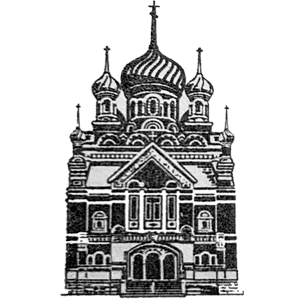


On July 12, 2021, the feast of the holy, glorious and all-praised chief apostles Peter and Paul, the Chairman of the Department for External Church Relations of the Moscow Patriarchate, Metropolitan Hilarion of Volokolamsk, and the First Hierarch of the Russian Church Outside of Russia, Metropolitan Hilarion of Eastern America and New York, celebrated the Divine Liturgy at the ROCOR Cathedral of the Sign in New York. Concelebrating with the hierarchs were Bishop Nicholas of Manhattan, the clergy of the Cathedral of the Sign and clergy of the Moscow Patriarchate parishes in the USA.
Addressing the DECR chairman with words of greeting at the end of the service, the First Hierarch of the Russian Church Outside of Russia said: “Your Eminence, greeting you fraternally on the feast of the chief apostles Peter and Paul, I sincerely thank you for the common prayer we have offered on this festal day, for your love, attention and words of instruction. I cannot find adequate words to express with what special feeling we celebrated the Divine Liturgy today.”
“Recalling the archpastoral labors of one of my predecessors, Metropolitan Anastassy (Gribanovsky), author of the popular ‘Conversations with My Own Heart,’ who was consecrated bishop on this day 115 years ago in the Dormition Cathedral of the Moscow Kremlin, we prayed today that Christ the Chief Shepherd would continue and multiply His mercies upon the spiritual unity between the Russian Church Abroad and the Church in the Homeland, which we achieved through fraternal love and great labor,” noted Metropolitan Hilarion of Eastern America and New York.
He emphasized: “We believe that this unity between us will serve as a source of grace-filled consolation and strengthening for all the children of the Local Russian Orthodox Church in the present difficult period for the Orthodox world.”
Addressing the First Hierarch of the Russian Church Outside of Russia and the clergy and parishioners of the Cathedral of the Sign, Metropolitan Hilarion of Volokolamsk conveyed to them the cordial greetings and blessing of His Holiness Patriarch Kirill of Moscow and All Rus’. “Today I rejoice with all my soul and heart at the opportunity to celebrate the Divine Liturgy in this historic church of the Russian Church Outside of Russia, which is its heart, where your predecessors prayed and served, dear Vladyka, including Metropolitan Anastassy, whom we prayerfully remembered today,” said the Chairman of the Department for External Church Relations of the Moscow Patriarchate.
Speaking of the feast celebrated that day, Metropolitan Hilarion of Volokolamsk noted:
“The feast of the holy apostles Peter and Paul takes us back to the very origins of Christianity, to the first generation of Christians, when after the Resurrection and Ascension of the Lord Jesus Christ into heaven the apostles began to preach Christ Crucified and Risen.
We read in the book of the Acts of the Apostles how these first steps of the Christian Church were taken: how the apostles sat in Jerusalem, how people brought their possessions and laid them at their feet, how the Church of Christ gradually and little by little spread. And the very first independent act of the church community was the election of a twelfth apostle in place of the fallen Judas. He was chosen by lot, the name of the one chosen was Matthias, and he is mentioned in the book of Acts only once — precisely in connection with this election.
But when we look at the icon of Holy Pentecost or at icons of the Synaxis of the Holy Apostles, we see there not Matthias but another apostle — we see the Apostle Paul, who was not a member of the apostolic community and was not a follower of the Lord Jesus Christ during His earthly life, but in the first years of the Church’s existence was its persecutor and opponent. Yet it pleased God to call this persecutor and make him a great apostle and preacher of Christianity.
While the first half of the book of Acts is devoted to the Apostle Peter and some other apostles, the entire second half is devoted to the missionary labors of the holy Apostle Paul, which were truly unparalleled: even if we simply look at the map of the journeys of the holy Apostle Paul often included in editions of the New Testament, we will see that he covered enormous distances that today can be flown in two, three or four hours. Paul, however, crossed all these lands on foot — and not in comfortable sports shoes, as people walk or jog in Central Park today, but barefoot or in sandals.
The Apostle Paul traveled many kilometers to bring the news of Christ Crucified and Risen to different corners of the earth. And to explain to the first Christians what this news meant, he sent his epistles to the churches that were being founded. Reading these epistles now, we often do not realize that at the time they were written the four Gospels did not yet exist: they were still being written and had not yet become the Holy Scripture of the Church. And when the Apostle Paul speaks of Holy Scripture, he means the Old Testament. He does not quote the Gospels, because they did not yet exist. That is, the earliest Christian writings that appeared belong to the holy Apostle Paul.
These two apostles — Peter, whom the Lord named a rock and to whom He said: upon this rock I will build my church; and the gates of hell shall not prevail against it (Matt. 16:18), and Paul, who was called later than the other apostles but who, as he himself says, labored more abundantly than all the others in the Gospel of Christ (cf. 1 Cor. 15:10) — are glorified by the Church as the chief apostles.
Moreover, we know that although during their lives the Apostles Peter and Paul met infrequently, and after their martyrdom they were buried in different places, nevertheless in both the Eastern and the Western Church their memory has always been celebrated together. And although later in the Western Church the Apostle Peter was exalted in order to create the doctrine of the primacy of the Bishop of Rome, supposedly passed on from the Apostle Peter, even there the liturgical feast of the apostles still remains one and the same. That is, these two apostles are inseparably linked in the memory of the Church.
It is no accident that many churches dedicated to the Apostles Peter and Paul were built in Holy Rus’, but we had no churches dedicated only to the Apostle Peter or only to the Apostle Paul. Why? Because their memory is celebrated on one day, and the patronal feast of a church of Sts. Peter and Paul always falls on the day of both apostles, not one of them.
Today we glorify these two great apostles, two preachers of Christianity, and admire their labors and their apostolic podvig. We glorify them as those who brought us the news of Christ Crucified and Risen, and we glorify the Apostle Paul in a special way as the first to reflect theologically on what the other apostles saw with their own eyes.
Reading the Gospel, we see that the apostles understood little of what was happening around them. The Lord Jesus Christ spoke parables, and the disciples asked Him: “Declare unto us this parable” (Matt. 15:15); Christ performed miracles, but their spiritual eyes remained closed, so that very often the Lord rebuked them for their lack of understanding. And only after the Holy Spirit descended upon the apostles on the day of Pentecost did they begin, recalling what they had seen, to realize what had happened and Who the Lord Jesus Christ really was: not simply a man, not simply a great prophet, but God become man, God Incarnate, Who came to save every person.
It fell to the Apostle Paul to explain in theological language this astonishing miracle of God coming into the world in the flesh. And to this day we base our theology precisely on what he preached to us. Celebrating the Liturgy of St. Basil the Great during Great Lent, we read the wonderful, long and profound prayers composed by that saint and could see that they are made up of nothing other than the words of the holy Apostle Paul. It was this apostle who laid the theological foundation of Christianity, and therefore his podvig is invaluable.
We glorify him together with the one who was called from the very beginning and who was the actual head of the apostolic community in the first years of its existence.”
Addressing the First Hierarch of the Russian Church Outside of Russia, Metropolitan Hilarion of Volokolamsk said:
“I would like to cordially congratulate you, dear Vladyka Metropolitan Hilarion, on this feast and thank you for the opportunity to pray and celebrate the Divine Liturgy together with you today in this wonderful church, where so many events in the life of the Russian Church Outside of Russia have taken place.
We feel our unity through the Divine Eucharist, which we celebrate together. We rejoice that the division that once existed, which arose not for church reasons but for reasons of a political nature, has been overcome in our time, before our eyes. And today we rejoice spiritually in our unity.
We live in an era when, unfortunately, a schism is taking place in the Orthodox Church because of the actions of the Patriarch of Constantinople, who in an anti-canonical manner recognized the Ukrainian schismatics. Today, instead of being healed, this schism is deepening and drawing in more and more Churches. But our Holy Russian Orthodox Church remains untouched by this schism. We continue to preserve our unity and our Church within its sacred borders, which we did not create — they were built over centuries, and it is not for us to destroy them.
Therefore, praying for the unity of the holy Churches of God, we pray that those who have fallen away from it may return to unity. At the same time, we rejoice that our Holy Church is preserved one, indivisible and unshakable.”
In memory of their joint service, Metropolitan Hilarion of Volokolamsk presented the First Hierarch of the Russian Church Outside of Russia with a panagia that had belonged to the vicar of the ROCOR Eastern American Diocese, Bishop John (Legky) of Rockland.
After the Liturgy the archpastors continued their fellowship over a meal, discussing matters of mutual interest. In particular, Metropolitan Hilarion of Volokolamsk informed the First Hierarch of ROCOR about preparations for the Council of Bishops of the Russian Orthodox Church scheduled for November of this year.