

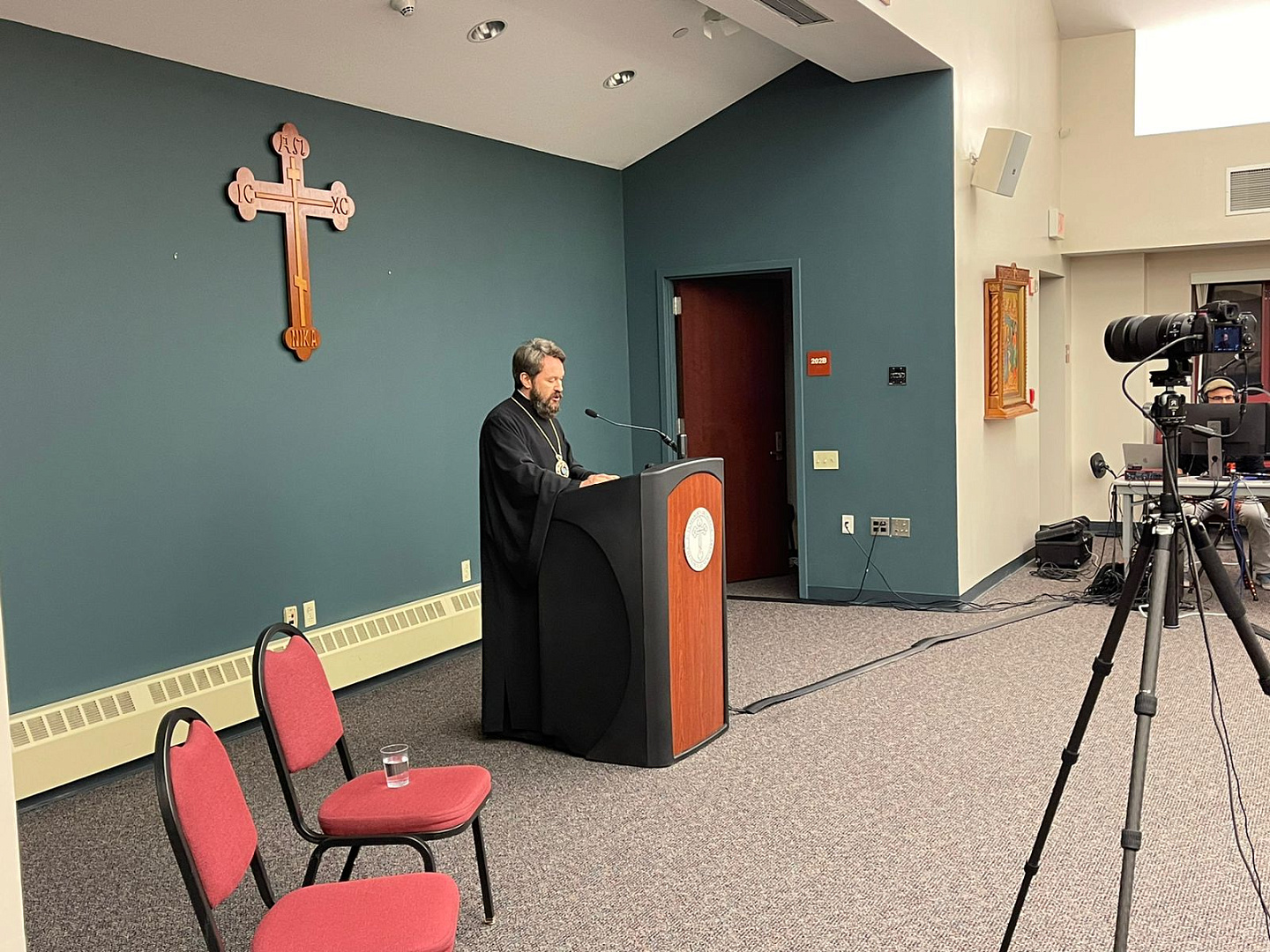
On November 11, 2021, the Chairman of the Department for External Church Relations of the Moscow Patriarchate, Metropolitan Hilarion of Volokolamsk, who was at St. Vladimir’s Orthodox Theological Seminary in New York with the blessing of His Holiness Patriarch Kirill of Moscow and All Rus’ and at the invitation of His Beatitude Metropolitan Tikhon of All America and Canada, spoke at the opening of the scholarly theological conference “Search the Scriptures,” devoted to the English translation of the Metropolitan’s six-volume study entitled “Jesus Christ: His Life and Teaching.”
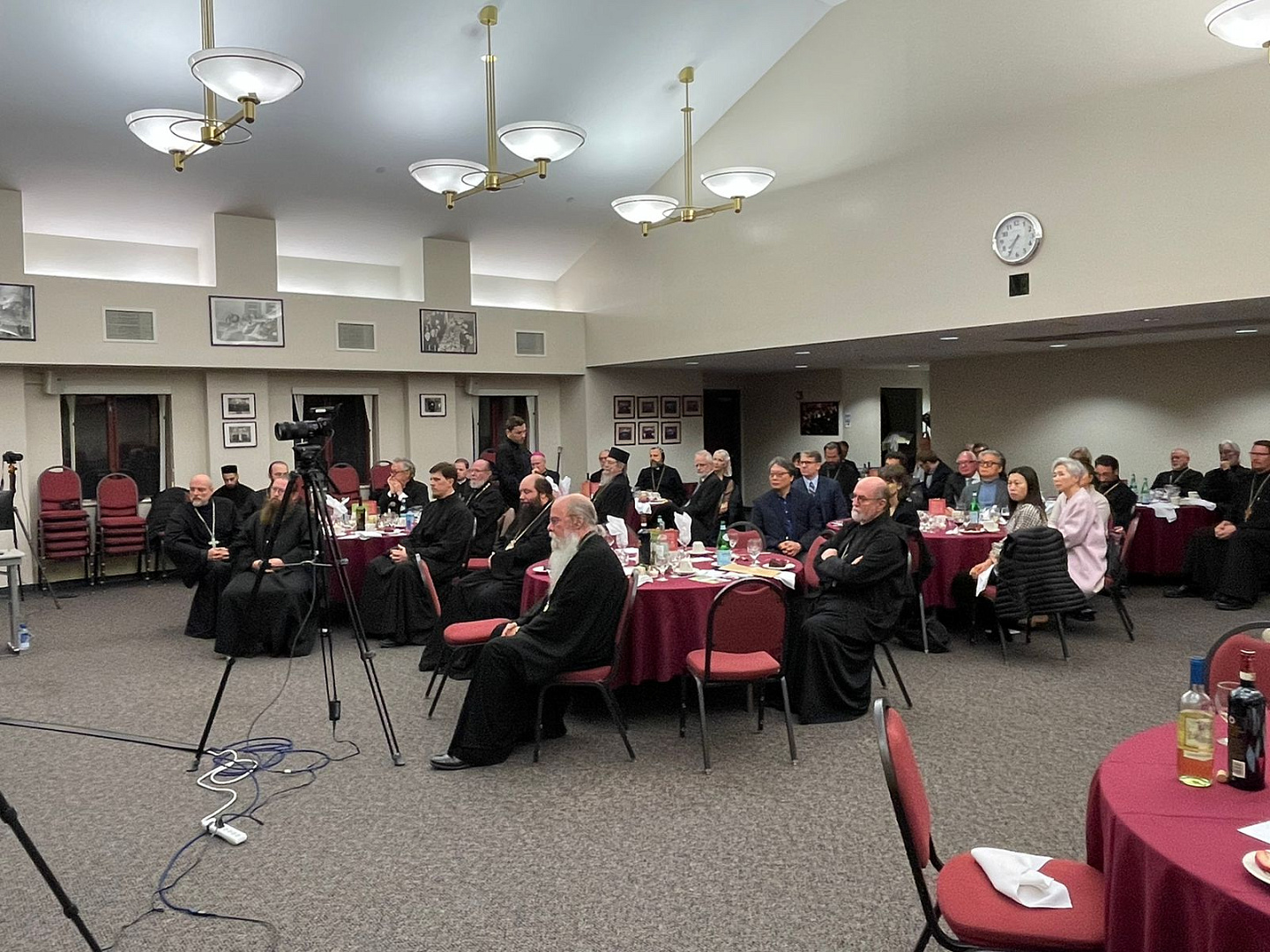
Before the opening of the conference, the rector of St. Vladimir’s Seminary gave a formal dinner in honor of the Chairman of the Department for External Church Relations of the Moscow Patriarchate. The dinner was attended by His Beatitude Metropolitan Tikhon of All America and Canada; hierarchs of the Orthodox Church in America Archbishop Michael of New York and New Jersey and Archbishop Melchisedek of Pittsburgh and Western Pennsylvania; the vicar of the ROCOR Eastern American Diocese, Bishop Nicholas of Manhattan; Metropolitan Mar Zacharias Nicholovos of the Northeast American Diocese of the Malankara Orthodox Church; the Patriarchal Vicar of the Syriac Orthodox Church in the USA, Archbishop Mar Dionysius John (Kawak); the rector of the Roman Catholic St. Joseph’s Seminary and College, Bishop James Massa; the Protosyncellus of the Antiochian Archdiocese of North America, Archimandrite Jeremiah (Davis); the Dean of St. Tikhon’s Orthodox Theological Seminary (OCA), Archpriest John Parker; the representative of the head of the Anglican Church in North America, Canon Christopher Culpepper; the Dean of Nashotah House Theological Seminary, Professor Garwood Anderson; the Dean of ROCOR’s Holy Trinity Orthodox Seminary, Ivan Shidlovsky; representatives of the Grace and Mercy Foundation led by its founder Bill Hwang; and numerous representatives of other Christian confessions working in the field of New Testament studies.
Opening the event, the seminary president, Archpriest Chad Hatfield, spoke about the cooperation of the institution he heads and its publishing house, SVS Press, with Metropolitan Hilarion, who in 2014 was awarded an honorary Doctor of Divinity degree by St. Vladimir’s Seminary. Over the past decade, eighteen of Metropolitan Hilarion’s books have been translated into English and published, including four of the six volumes of the monograph “Jesus Christ: His Life and Teaching.” The most recent volume translated and published is devoted to the parables of Jesus Christ.
The seminary president then gave the floor to Metropolitan Hilarion of Volokolamsk, who opened the scholarly theological conference with a keynote address on “Jesus Christ and His Parables.”
In the first part of his address, Metropolitan Hilarion spoke about how the six-volume monograph on Jesus Christ was created and about the main problems of Western New Testament scholarship that an Orthodox researcher has to face. “For more than two hundred years,” he noted, “New Testament scholarship has developed under the influence of myths created by scholars. A given myth would first arise in the mind of a researcher or group of researchers; then other scholars would pick it up and begin to analyze, supplement, develop and dispute it. As a result, the subject of scholarly inquiry became the myth rather than the Gospel text itself, which was used only as an aid to prove the correctness of the myth’s creators.”
Among such myths is, in particular, the notion that the Gospels were written for specific audiences, namely for the church communities to which the evangelists belonged. The essence of this theory is that at the end of the first century there existed isolated Judeo-Christian communities, persecuted by pagans and going through various internal crises connected with conflicts between converts from paganism and from Judaism. The Gospels supposedly arose within such communities, with the aim of strengthening their members in the faith, comforting them in persecutions from “outsiders” and reducing internal conflict. Each community, according to this view, “projected its own problems and questions onto the stories of Jesus’ life,” and the Gospel text is supposedly to be understood in the light of these problems and questions. In practice this concept is applied as follows: first, on the basis of the text of a particular Gospel, conclusions are drawn about the main characteristics of the hypothetical community in which it was written, and then the same text is examined in the light of those conclusions.
The speaker called this approach mistaken and flawed for a number of reasons. First, it undermines confidence in the Gospels as historical sources containing reliable information about what Jesus Christ did and taught, since it turns Jesus into a literary character created by a given author for specific pastoral needs. Second, it underestimates the role of inter-church communication in the first century, when there was a wide communication network among various Christian communities that allowed rapid and regular exchange of all kinds of information: in such a situation it is hard to imagine an author writing a text of the caliber of any of the four Gospels based on the narrow needs of his own community without having in mind potential readers from other communities (not to mention future generations of readers). Finally, third, this approach is based on the paradigm of “literary thinking,” according to which the entire process of creating the Gospels took place in a study and consisted of writing and editing texts. This paradigm does not take into account the features of the oral tradition within which the Gospels or their prototypes — individual episodes from the life of Jesus and His individual sayings — evidently existed for a rather long time.
Metropolitan Hilarion called on the scholars in the hall to work together on the “demythologization” of New Testament scholarship, that is, freeing it from myths created by scholars in the 19th and 20th centuries that have no basis in the text of the New Testament. The future direction of New Testament studies largely depends on the successful solution of this task, the speaker emphasized.
In the second part of his address, Metropolitan Hilarion spoke about the parables of Jesus Christ. According to him, Jesus’ parables “are the most difficult layer of His direct speech to interpret. Even for His contemporaries they were for the most part incomprehensible, as is confirmed by the disciples’ repeated attempts to obtain an explanation of one parable or another.” One explanation of why Jesus spoke in parables “is based on the fact that the very image of Jesus, His miracles and His preaching had a twofold effect on people: in some they strengthened faith, while in others, on the contrary, they provoked rejection and hatred.”
Simple but convincing answers to the question of why Jesus spoke in parables are given by John Chrysostom. In his view, Jesus spoke in parables “for greater vividness” and used “veiled” speech because He spoke of lofty things. According to the saint, “at first He did not speak to them in parables, but simply and clearly. But since they began to listen to Him unwillingly, He at last began to speak to them in parables.”
The genre of the parable, the speaker went on to note, is one of the intermediate links between prose and poetry. Parables are as a rule set out in prose form, but their imagery, language, concise form and the sayings and refrains that often accompany them (“he that hath ears to hear, let him hear”; “many are called, but few are chosen”; “the last shall be first, and the first last”) — all this brings parables close to poetry and gives them a poetic coloring. Accordingly, the listener’s perception of parables is close to how people perceive poetry. In a poem, the reader as a rule does not look for a moral, conclusions or instructions: far more important are the images, sound, rhythm, wordplay and other devices of poetic craft.
A parable, moreover, has a certain similarity to a fable or a fairy tale. Like a fable, it is built on the principle of metaphor and in some cases ends with a direct indication of how the metaphor relates to reality. Like a fairy tale, a parable does not claim to be realistic and may contain all sorts of fantastic details and end sooner than the listeners would like. After hearing a fairy tale or fable, children sometimes ask, “And what happened next?” Adults find this question out of place and comical, since they know the laws of the genre. The genre of the parable also has its own laws. One of them is that not all details of a parable are equally important, and not every detail requires interpretation. It is no accident that St. John Chrysostom said that “not everything in the parables should be given attention.”
Concluding his address, Metropolitan Hilarion noted that “the Church is the guardian and authoritative interpreter of Jesus’ teaching. It is within the Church that over many centuries an exegetical tradition developed which enabled many generations of Christians to understand the meaning of the parables, apply them to their own life situations and draw moral lessons and spiritual instruction from them. Falling into neither excessive allegorism nor excessive literalism, interpreters such as John Chrysostom projected Jesus’ parables onto the situation of their contemporaries, helping them to perceive the parables not as theoretical propositions, which they never were, but as a guide to action.”
At the same time, according to the DECR chairman, “no church community can ‘privatize’ Jesus and His teaching or declare itself the exclusive owner of the rights to His legacy. Jesus is broader than the Church, because He is God Himself, Who came to people in human flesh. The significance of His person and teaching is so universal and all-embracing that it goes beyond the boundaries of the Church. Jesus belongs to the whole world and to every person. He has something to say to everyone — to those already in the Church, to those on the way to it, and to people far from it and from religion and religiosity in general.” And Jesus’ parables “belong not only to the Church and not only to believers. They belong to all humanity. They are able to say something of their own to each person.”
Metropolitan Hilarion’s address was attended by His Beatitude Metropolitan Tikhon of All America and Canada and the other participants in the dinner given in honor of the guest from the Russian Orthodox Church by the seminary president, Archpriest Chad Hatfield. About a thousand more people listened to the address remotely.
The conference will continue on November 12 with presentations by leading American New Testament scholars, including Professor Emeritus Carl Holladay of Emory University’s Candler School of Theology; Craig Keener, Professor of Biblical Studies at Asbury Theological Seminary; Gregory Sterling, Professor of New Testament at Yale University; Edith Humphrey, Professor Emerita at Pittsburgh Theological Seminary; Professor Garwood Anderson, Dean of Nashotah House Theological Seminary; John Barnet, Assistant Professor of New Testament at St. Vladimir’s Orthodox Theological Seminary; Bruce Beck, Assistant Professor of New Testament at Holy Cross Greek Orthodox School of Theology in Brookline, Massachusetts; and James Wallace, Dean and Professor of Religion and Philosophy at Christian Brothers University in Memphis, Tennessee.