

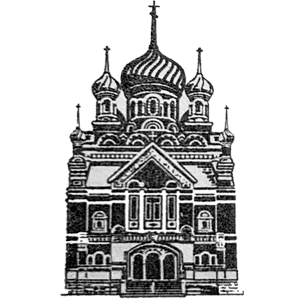
For the 120th anniversary of the great consecration of St. Nicholas Cathedral in New York by St. Tikhon, we begin a series of publications from the American press of that time describing the event.
Materials prepared by Igor Lugovoy and Taisia Ryabtseva.

NEW RUSSIAN ORTHODOX CHURCH CONSECRATED
Bishop Tikhon of the Aleutians and North America Officiates.
AMBASSADOR CASSINI PRESENT
American Flag Carried In with Russian Standard — Band of Cossacks Takes Part — Bishop Grafton of Fond du Lac Present in the Chancel.
With all the pomp of ritual and splendor of the clergy’s vestments, in the presence of members of the Russian Embassy and before a throng of worshipers that filled almost every inch of the church, the new Russian Orthodox Church of St. Nicholas was consecrated yesterday morning. The building at 15 East 97th Street was decorated at the entrance in red, white and blue in honor of the American flag, and in white, blue and red in honor of the flag of Russia.
Delegations of Russian societies entered the church with the national flag, the colors of their new adopted country and a banner bearing images of the Savior, the Virgin Mary and the saints. On one side it was pink and silver, and on the other blue and gold. Count Cassini, Countess Marguerite and members of the Russian Embassy with their ladies sat to the right of the altar. The Ambassador and his suite were in the full uniform of their several ranks and glittered with gold lace and jeweled medals and orders. A band of Cossacks from Buffalo Bill’s “Wild West” show, in uniform including cartridge belts, added picturesqueness to the scene.
A stunning visual effect came from the flower-decked painted doors of the iconostasis, which lead into the sanctuary, where most of the service took place and where the altar was consecrated. The church was lavishly decorated with palms and chrysanthemums. On either side of the swinging doors, which reach neither the floor nor the painting of “The Last Supper” above them, are images of the Mother of God and the Savior. The Holy Synod sent the altar furnishings from Russia.
Golden crosses and insignia gleamed yesterday for the first time in the sunlight that streamed through stained-glass windows of blue and yellow. Hundreds of candles in the sanctuary added light, and many of the congregation held their own candles throughout the service, which lasted 3 hours and 15 minutes. Yesterday’s service consisted mainly of chanting, in which the congregation did not join. There was no organ or other instrumental music. The priests in their gold and silver vestments chanted the prayers, responses and psalms. A male choir sang.
EASTERN CLERGY PRESENT.
The clergy who took part in the service with the Right Reverend Tikhon, Bishop of the Aleutians and North America, were:
The rector, Archpriest Alexander Hotovitzky,
Assistant rector, Priest Ilya Zotikov,
Archimandrite Anatoly, president of the Russian Theological Seminary, Minneapolis,
Archimandrite Raphael, rector of the Syro-Arab Church in Brooklyn.
Archpriest Alexis Toth, Wilkes-Barre, Pennsylvania.
Archpriest John Nedzelnitsky, Allegheny, Pennsylvania.
Priest B. Turkevich, Bridgeport.
Priest Ptolemy Timchenkov, Ansonia, Connecticut.
Priest John Kochurov, Chicago.
Priest Alexander Vemolovsky, Philadelphia.
Priest Ilya Klopotovsky, Old Forge, Pennsylvania.
Priest V. Kalnev, Buffalo.
Priest Kagnodze, Cleveland.
Priest Tikhon Rostovsky, Troy.
Priest Anthony Dovoshchank, Passaic, New Jersey.
Priest Ioanaviski, Osceola Mills.
Priest Fyodor Bukelov.
With them was Bishop Grafton of Fond du Lac. The Protestant Episcopal bishop was present to return the courtesy of Bishop Tikhon, who had attended the consecration of a Protestant Episcopal church in San Francisco. The pointed miter of the Anglican bishop contrasted sharply with the rounded golden miter of the Russian prelate.
The services began yesterday at 10 o’clock in the morning. The church was crowded. Chairs had been set out, but the worshipers stood, as is the custom in Eastern churches. It was noticeable, however, that members of the Russian Embassy sat, as representatives of the Czar and in keeping with etiquette, so as not to embarrass the visitors.
Next to the Russian Ambassador sat Mayor Seth Low, to whom Count Cassini explained the meaning of what was taking place.
The clergy performed the rite of the blessing of water. Then they greeted Bishop Tikhon at the entrance to the church while the choir sang the hymn: “From the rising of the sun unto the going down of the same the Lord’s name is to be praised.”
The bishop prayed before the altar and blessed the people, holding in each hand a silver candlestick with three candles whose lighted tips joined in a single flame, symbolizing the Trinity. Then he proceeded to the dais in the center of the church, where he was vested in magnificent vestments according to the custom of the Eastern Church. Over them a white tunic was put on. Then the clergy put on their tunics, preparing to vest the altar.
Accompanied by the bishop, all the clergy entered the sanctuary to the reading of prayers and psalms. The altar table was fixed in place, the loud blows of the hammer rising above the chanting. Then it was sprinkled with holy water, rose water and wine, anointed with holy oil, and the first covering was placed on the table and tightly bound with a cord. Then the second covering was placed on it, upon which were laid the antimension, the tabernacle, the Book of the Gospels and the cross, glittering with gold and precious stones.
Led by a deacon carrying a lighted candle, the bishop censed the altar and the church, accompanied by the priests, one of whom sprinkled the four walls with holy water and anointed them. Returning to the altar, the bishop lit a candle from the censer, from which other candles were lit. Then he took off much of the gold and jewels and placed upon his head the antimension containing holy relics. Accompanied by the flag of Russia and a church banner, the bishop went out into the street with the clergy.
Returning to the main entrance, he cried out from outside: “Lift up your gates, O ye princes, and be ye lift up, ye everlasting doors; and the King of glory shall come in.”
The choir sang: “Who is this King of glory?”
“The Lord of hosts, He is the King of glory!” exclaimed the bishop. Entering the church again, he placed the holy antimension on the altar and then read a prayer for the founders of the church.
Gathering in the center of the church with all the clergy, the bishop blessed everyone with the cross, turning to the four sides so that all might be blessed. The deacon intoned a short litany containing petitions for all present.
Many Years to the President
After the blessing, Many Years was proclaimed to the Imperial House of Russia, the President of the United States, the Holy Synod, the Right Reverend Bishop Tikhon, the founders, the parishioners and all the people. Then “Memory Eternal” was proclaimed for the departed benefactors of the Church.
The bishop spoke in Russian, and the rector preached in English. The people were urged to be loyal to their adopted country, to their Church and to themselves in leading righteous lives.
At the conclusion of the consecration ceremony, the regular church service, the liturgy of St. Chrysostom, was celebrated. Several small children and parishioners received communion, and then, after the members of the Church had kissed the cross held in the bishop’s hand, they departed.
The invited guests went to the rectory, where a reception was held in honor of the bishop, who was assisted by his fellow clergy and the ladies of the Russian Embassy. Among those present were Count Cassini, Countess Marguerite, the Canadian Consul N. Struve, the Russian Consul General Lodyzhensky, Vice-Consuls K. Karasen and C.H. Christen Petersen, Miss de Planck, Mrs. Charles H. Boynton, Bishop Grafton and the Rev. Dr. W.R. Huntington.
Construction of the new church was begun about two years ago and cost $150,000, of which the Czar is said to have contributed $50,000. It is built of stone and brick. It has five domes of the Russian architectural type. They are surmounted by gilded crosses.
Some of those present who have followed the affairs of the Russian Orthodox Church in America had the impression that the new home here would lead to the see of Bishop Tikhon being moved from San Francisco, as it had been moved many years ago from Sitka, Alaska.