

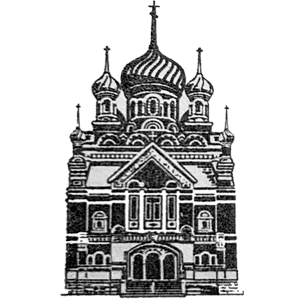
An illustrated article from the New York “World” on the great consecration of St. Nicholas Cathedral on November 23, 1902, as well as statistics on church attendance in the USA by Christians of different denominations.
Prepared by Igor Lugovoy and Taisia Ryabtseva.

Russian Church Formally Opened.
Archbishop Tikhon and 16 Priests Take Part in Impressive Ceremony. Russian Ambassador and Mayor Low Present. After the Service the Mayor and the Archbishop Converse in French.
With particular splendor the consecration of the new Russian Church of St. Nicholas at 97th Street and Fifth Avenue was celebrated yesterday. Archbishop Tikhon of San Francisco, assisted by 16 priests, performed the service of consecration. Also present were Count Cassini, the Russian Ambassador in Washington, and Nikolai Lodyzhensky, the Russian Consul General, with their suites in magnificent uniforms.
Hundreds of people crowded into the new church until it was impossible to pass through the aisles. At times the crush became so great that women were close to fainting, and had it not been for the efforts of the attendants and the Cossacks in uniform and armed, a panic might have occurred.
The ceremony lasted from 10 o’clock in the morning until 2 o’clock in the afternoon. At 10 o’clock Archbishop Tikhon, with Archimandrite Raphael, the Arab abbot, both wearing miters, Archpriest Alexander Hotovitzky, rector of the new church, and 16 other priests from different parts of the country entered the building. They performed the rite of the blessing of water and the veneration of the cross. A choir of priests and a lay reader sang.
Archbishop Tikhon censed the altar with a golden censer, together with the deacon and priests. One of them sprinkled the four walls of the church with holy water, and another anointed the walls with consecrated oil.
Five large candles were lit, the choir sang church hymns, and Archbishop Tikhon entered the altar again, then led the procession of priests out into the street. The exterior walls of the church were consecrated, after which the archbishop and clergy returned to the center of the church, commemorating the founders of the new church. The concluding prayer was read, after which Many Years was proclaimed to the Czar, the Russian Imperial House, the President of the United States, the Holy Synod, the Most Reverend Archbishop Tikhon, the founders and builders of this church, and all the people. Prayers were also offered for the repose of the departed donors.
Having taken off his archiepiscopal vestments, Archbishop Tikhon addressed all present in Russian. He thanked everyone for building such a beautiful church and said that all who had a part in its construction would receive a great reward. The archbishop said that, on the whole, the Russians are a reverent and religious people, and that he was sure all rejoiced when they learned that such a majestic cathedral had been built in New York, where so many of their compatriots come. He spoke warmly of Rector Hotovitzky and commended him to the congregation.
Following the bishop, Rector Hotovitzky addressed those present with a short sermon in which he told how the new church had been built. He thanked all who had contributed and said that the Orthodox Russian Church in New York would now live a new life and with great enthusiasm.
After the final blessing of the hierarchical liturgy, which, like the entire ceremony, was in Greek, the priests gave communion to a number of dignitaries present at the ceremony.
The archbishop received as guests Bishop Grafton of the Episcopal Church and the Rev. Dr. Huntington of the Episcopal Grace Church, who sat in the chancel throughout the service. Bishop Grafton, who was dressed in the purple vestments of his church, resides in Fond du Lac, Wisconsin, and Archbishop Tikhon was one of the dignitaries present when Bishop Grafton was consecrated several years ago. Bishop Grafton came to New York to return the courtesy.
Mayor Low attended the ceremony and sat in the front row throughout the service. When it was over, he called on the archbishop at the rectory, and they conversed a little in French. Afterward the Mayor drove off in his automobile to his residence.
Only One-Third of the Population Attends Church
Of the adult residents of Manhattan, 451,731 attend Christian worship and 997,189 stay away — the result of an actual count on three Sundays — Men make up only 31% of the total attendance
There are 366 places of public Christian worship on Manhattan Island. The number of official members, Protestant and Catholic together, is reported to be 693,312.
On each of the first three Sundays of this month, at the public services held morning, afternoon and evening in all these places, 451,731 adults attended church, by actual count. Of this number, 139,591 were men. The population of Manhattan Island is 1,939,162. This number includes 482,973 persons under 15 years of age. In counting attendance, children were not counted either at services or in Sunday schools. Thus, leaving children out of account, on each of the first three Sundays of this month 451,731 persons attended public religious worship and 997,189 did not.
These figures do not take into account visitors to the city who may have attended religious services but are not part of the population. On the other hand, they do not account for the large attendance at Jewish synagogues. Of the total number of people attending all services each Sunday, 134,377 were Protestants and 317,151 attended Roman Catholic services.
The counts underlying the foregoing statements were made under the direction of the Church News Association by persons specially engaged and in many cases paid for attending each service at a particular church. The estimates of clergy and church officials were not taken into account. Of the total of 366 places of worship, very careful counts were made on all three Sundays in all the churches mentioned except about 20.
Favorable Conditions for the Count.
Three Sundays were chosen in order to obtain an average, and November was taken because people, with rare exceptions, are in the city, and the season includes neither Christmas nor Lent, when unusual conditions might influence the result. An important consideration is that the weather was pleasant on all three Sundays, so rainy days could not affect the result either. No reliable data exist for previous years, so it is impossible to determine by comparison whether conditions are improving or the reverse. Much has been said lately about unfavorable conditions, especially among Protestants. The figures show that, in proportion to stated membership, the difference between Protestant and Catholic attendance is smaller than had been supposed. It is now proposed to repeat the count annually, so that within a few years some basis for calculating progress may be obtained.
Taking all religious bodies together, 65% of their stated members attended public worship on each of the three Sundays named. Broken down, the percentages show 77% for Protestants and 60.75% for Catholics. Here are the attendance figures of religious bodies in proportion to stated membership:
Methodist Episcopal 1.37
Disciples of Christ 1.27
Reformed 1.11
Baptist 0.99
Christian Science 0.97
Congregational 0.90
Presbyterian 0.735
Roman Catholic 0.6072
Protestant Episcopal 0.59
Lutheran 0.69
The explanation of the above figures, striking in some respects, is the fact that small churches are attended by far more people in proportion than larger ones; in dozens of cases churches with a membership of 100 to 260 report attendance exceeding their membership, but when membership reaches the thousands, proportional attendance falls. This largely accounts for the apparent disproportion of the Roman Catholics, Episcopalians and Presbyterians with their large churches compared with the many small Methodist parishes and the two small Disciples of Christ churches in the district.
Most striking, perhaps, is the number of men attending religious services compared with the number of women. Everyone knows that women attend church much more often than men, but curious fluctuations are observed among the various religious bodies. The highest percentage of male attendance is in the Congregational Church, and the lowest in the Roman Catholic. In only one of all the churches counted, the Broadway Tabernacle (Congregational), were more men than women present at every service. Below are the percentages of male attendance, averaged over three Sundays, for the various denominations:
Congregational 0.51
Methodist Episcopal 0.61
Presbyterian 0.48
Reformed 0.41
Disciples of Christ 0.41
Baptist 0.41
Christian Science 0.38
Lutheran 3.75
Protestant Episcopal 8.35
Roman Catholic 0.23
In all churches, the share of men in total attendance was 31%; in Protestant churches alone, 40%.