

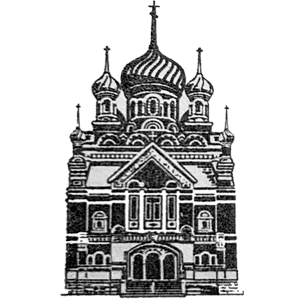
An illustrated article from the New York “Tribune” on the great consecration of St. Nicholas Cathedral on November 23, 1902.
Prepared by Igor Lugovoy and Taisia Ryabtseva


Consecrated with Splendor and Pomp
Archbishop Tikhon Leads the Ceremony at the Russian Church
Ambassador Cassini, Bishop Grafton, Mayor Low, Dr. Huntington and many others attended the impressive service.
The new Russian Orthodox Church of St. Nicholas at 15 East 97th Street was consecrated yesterday morning with all the pomp characteristic of the Russian Church. Nearly all the Russian officials were present, along with many clergy from the eastern part of the country; several priests from the Western states also came here for the ceremony.
Clad in splendid vestments, Archbishop Tikhon entered the church at 10 o’clock and proceeded to the altar. According to the rites, all except those physically unable must stand during the service. Archbishop Tikhon does not speak English, and the entire service was in Russian. The clergy performed the rite of the blessing of water and, fully vested, met Archbishop Tikhon with the cross at the entrance to the church, while the choir sang church hymns.
The archbishop prayed before the altar and, having blessed the people, proceeded to the dais, where the clergy vested him in episcopal garments. Accompanied by the archbishop, all the clergy entered the altar while the choir sang prayers and psalms. The altar table was fixed in its place, sprinkled with holy water, rose water and wine, anointed with holy oil; the first covering was placed on it and tightly bound with a cord. Then the second covering was put on, upon which the antimension, the tabernacle, the Book of the Gospels and the cross were then placed.
Accompanied by a deacon carrying an unlit candle, the archbishop censed the altar and the church together with the priests. One of them sprinkled the inner walls with holy water, and another anointed them with oil. Returning to the altar, the archbishop lit a candle from the censer, from which other candles were lit. Then he and the clergy went in procession outside the church, returning to the main doors. Outside the door the archbishop exclaimed: “Lift up your gates, O ye princes, and be ye lift up, ye everlasting doors; and the King of glory shall come in.” The choir asked: “Who is this King of glory?” And with the exclamation “The Lord of hosts, He is the King of glory!” the archbishop entered the church and placed the holy antimension on the altar. Then a prayer for the founders of the church was read.
All the clergy gathered in the middle of the church, and the archbishop gave the blessing with the cross toward all four sides of the church. The deacon intoned a short litany containing petitions for all present, and the choir responded to each petition: “Lord, have mercy.”
After the blessing, “Many Years” was proclaimed to the imperial house of Russia, the President of the United States, the Holy Synod, Archbishop Tikhon, the founders and parishioners of the church and all the people. “Memory Eternal” was proclaimed for the departed benefactors. Then followed the Liturgy of St. John Chrysostom.
Archbishop Tikhon rewarded the priests for the work they had done. The vestments and miter worn by the archbishop were made of silver, and the vestments of the clergy were embroidered with gold.
After the service, Archbishop Tikhon held the cross while the people filed past and kissed the cross and his hand.
Bishop Grafton of the Episcopal Diocese of Fond du Lac, Wisconsin, attended the service in full episcopal vestments. At the consecration of Bishop Coadjutor Weller, perhaps the most elaborate service ever seen in the Episcopal Church in this country, considerable comment was caused by the presence and participation of representatives of the Polish and Russian churches. Bishop Grafton attended yesterday’s service to return the courtesy extended by the Russian Church. The Rev. Dr. William R. Huntington, rector of Grace Church, also sat in the chancel. He wore an ordinary black clerical suit.
Count Cassini, the Russian Ambassador, and Nikolai Lodyzhensky, the Consul General, the guests of honor, stood at the far left of the chancel throughout the ceremony. With Count Cassini were Countess Cassini; Mademoiselle de Planck of Paris; Alexander Pavlov, Russian Minister to Korea; Theodore Hansen, First Secretary of the Russian Embassy in Washington; P. Rozhdestvensky, Second Secretary, Washington; M. Rudokov, A.Ya. Rutkovsky, Baron Fersen and Baron Schlippenbach, attachés of the Russian Embassy; N. Struve, Russian Consul in Canada; K. Karasov and Charles Peterson, vice-consuls in New York; and M. Tucker, vice-consul in Philadelphia.
Also present at the service were Mayor Low and a number of other municipal officials, who sat in one of the front rows of seats. Immediately after the ceremony the Mayor called on the archbishop at the rectory.
Among the clergy present at the ceremony were Archpriest Alexander Hotovitzky, rector of the church; Priest Ilya Zotikov, assistant rector; Archimandrite Anatoly, president of the Missionary College in Minneapolis; Archimandrite Raphael, rector of the Orphanage Church in Brooklyn; Archpriest Alexis Toth of Wilkes-Barre, Pennsylvania; the Revs. B. Turkevich of Bridgeport, Connecticut; Ptolemy Timchenkov of Ansonia, Connecticut; John Kochurov of Chicago; Alexander Femolorsky of Philadelphia; Ilya Klopotovsky of Old Forge, Pennsylvania; U. Kaluev Buff, Jason Kagnodge of Cleveland, Ohio; Tikhon Rostovsky of Troy, New York; Anthony Doroshchek of Passaic, New Jersey; Ioanniski of Osceola Mills, Pennsylvania; Fyodor Buketov of Shepton, Pennsylvania; and Toana Redzelnitsky of Pittsburgh.
After the service, a dinner was served at the rectory for the clergy, members of the embassy and invited guests.
Ten Cossacks from Buffalo Bill’s “Wild West” show were conspicuous in the church. They wore costumes with orange and white capes and white and black papakhas. Members of the Greek and Assyrian societies were present with the flags of their societies.
Archbishop Tikhon is the head of the Russian Church in North America and the Aleutian Islands. He was accompanied here and assisted in yesterday’s ceremonies by Hierodeacon Ilya.
It is understood that the archbishop’s residence may soon be moved to New York. This is the first Russian church built in New York. It was built on the model of the churches of St. Petersburg at the request of the Czar, who contributed a large sum toward its construction. The church cost $140,000. The marble altar from St. Petersburg has not yet arrived, and a temporary one was built for yesterday’s service. It was decorated with chrysanthemums and evergreens, and palms were placed around it. The flowers were donated by Charles Crane of Chicago. The seven crosses on the church symbolize the seven sacraments. Red brick was chiefly used, and the exterior ornamentation is of terra cotta and white sandstone.
More than 500 people attended yesterday’s service, and 40 policemen were stationed in the church. This was done chiefly to protect the embassy staff.