

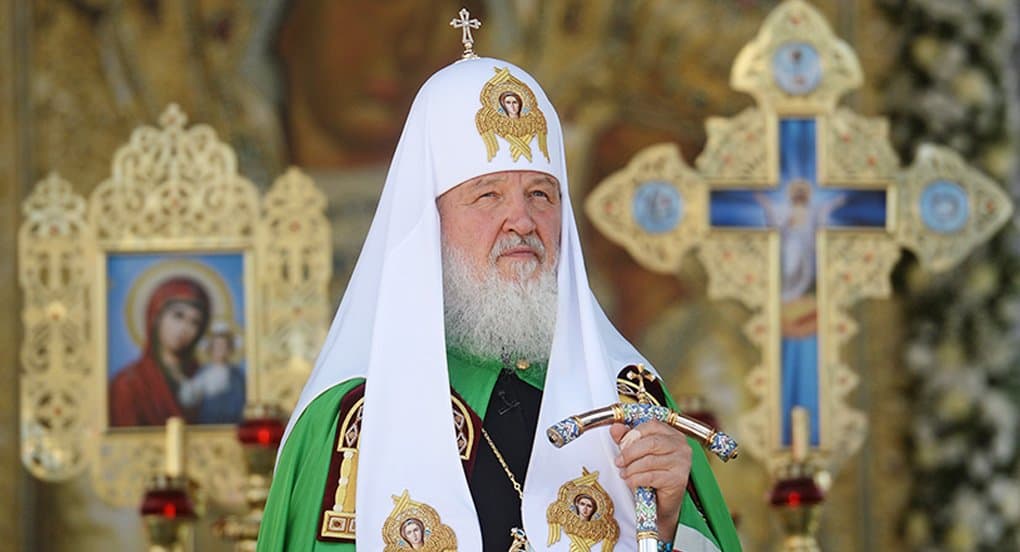
His Holiness Patriarch Kirill of Moscow and All Rus' addressed the archpastors, pastors, deacons, monastics and all faithful children of the Russian Orthodox Church in connection with the celebration of the 1700th anniversary of the First Ecumenical Council.
Beloved in the Lord Most Reverend archpastors, all-honourable presbyters and deacons, God-loving monks and nuns, dear brothers and sisters: CHRIST IS RISEN!
Today, on the 7th Sunday of Pascha, the Orthodox Church prayerfully commemorates and glorifies the podvig of the holy fathers of the First Ecumenical Council, which took place in 325 in Nicaea — a small city not far from Constantinople. This year marks 1,700 years since this epoch-making event in church history.
About three hundred bishops and their representatives came from virtually every corner of the Christian world to take part in the discussion of one of the most acute questions, which for several decades had caused fierce disputes and was literally tearing the Church apart. The minds of many people had been captured by the error of the Alexandrian presbyter Arius, who held that the Son of God is not true God but only His highest creation. In asserting this, Arius tried to rationalize the faith and turn the great mystery of godliness — the Incarnation (1 Tim. 3:16) into an abstract philosophical doctrine.
The Arian heresy touched the very depths of the Christian faith and distorted the Gospel witness to the salvation of the world, for the sake of which the Word was made flesh, and dwelt among us, full of grace and truth (John 1:14). The Church rejected this false teaching, condemning it by its conciliar mind and formulating the crucial dogma of the consubstantiality of the Son with the Father, which we confess in the Creed proclaimed at the Divine Liturgy. As the outstanding church historian Professor Vasily Vasilyevich Bolotov writes, “The Nicene Creed was so precise that it could not be reinterpreted — it could only be accepted or rejected”(Lectures on the History of the Ancient Church, Vol. 4).
The history of the Church is not only academic research into past events and stories of deeds of days long gone, legends of deep antiquity, like the time-darkened pages of a dusty book. In the history of the Church the Holy Spirit lives and acts, guiding us into all truth (John 16:13). That is precisely why the study of church history — to which I earnestly call all of you — helps us better understand many phenomena in contemporary religious life, teaches us to distinguish the essential from the secondary and to discern spirits (1 Cor. 12:10), comprehending God’s wise Providence for the Church.
From the very beginning of its historical existence, the Church has been and remains a community of believers in Christ who experientially know and live unity in the Sacrament of the Holy Eucharist, when we with one mouth and one heart confess faith in the Holy Trinity and partake of the one Cup of Christ. The Holy Spirit teaches the Church to respond to the challenges of the times with a conciliar mind and in fraternal dialogue. So it was at the first Council of the apostles in Jerusalem, which became a turning point in the spread of the good news and determined the universal scope of the Church’s mission. So it was at the Council of Nicaea in 325, which won a dogmatic victory over the heresy of Arius and rejected that teaching as contrary to the very foundations of the Christian faith. So it was at the subsequent holy Councils. And so — we believe and hope — it will be henceforth until the end of the age.
Today, when world Orthodoxy is going through a very difficult time, when a deep theological understanding of ecclesiological problems is required, we testify again and again with conviction: the most important decisions affecting the foundations of the Church’s existence and its faithfulness to the apostolic teaching and canonical order, concerning the fulfillment of its saving calling to be the pillar and ground of the truth (1 Tim. 3:15), must be made together, in the unity of the Spirit and the bond of peace (Eph. 4:3).
We invariably bear witness to this and pray that, through the intercession of the holy fathers of the First Ecumenical Council, the All-Bountiful God will mercifully look upon His Church and grant its faithful children strength and wisdom, courage and steadfastness to remain the salt of the earth and the light of the world (Matt. 5:13-14), to be His bold witnesses unto the uttermost part of the earth(Acts 1:8), until Christ comes.
Invoking upon all of you, my dear ones, God’s peace and blessing, I wish you growth in love and in the knowledge of our Lord and Savior Jesus Christ, to Whom belongs all glory, honor and worship, together with the Father and the Most Holy Spirit, now and ever, and unto ages of ages. Amen!
+KIRILL, PATRIARCH OF MOSCOW AND ALL RUSSIA